Friday, December 29, 2006

Hmmm.

I hope everyone's having a good Christmas season. I'll post a real update later. Meanwhile, here's a quiz, ripped from Another Episcopalian Blog:

You scored as Emergent/Postmodern. You are Emergent/Postmodern in your theology. You feel alienated from older forms of church, you don't think they connect to modern culture very well. No one knows the whole truth about God, and we have much to learn from each other, and so learning takes place in dialogue. Evangelism should take place in relationships rather than through crusades and altar-calls. People are interested in spirituality and want to ask questions, so the church should help them to do this.

Emergent/Postmodern


82%

Roman Catholic


75%

Neo orthodox


61%

Evangelical Holiness/Wesleyan


61%

Classical Liberal


54%

Modern Liberal


46%

Charismatic/Pentecostal


43%

Reformed Evangelical


4%

Fundamentalist


0%

What's your theological worldview?
created with QuizFarm.com


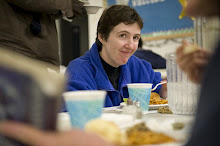
Great, and probably accurate enough, except for the line about "older churches." I'm a thoroughly committed Episcopalian. I love liturgy too much not to be. Also, I don't know who the man in the picture is. Oh well.

Tuesday, December 12, 2006

Forgiveness

Remember the Christian Peacemaker Team workers who were kidnapped in Iraq in November 2005?

News comes from Sheila Provencher, a fellow CPT member and friend of theirs, that the men who kidnapped them have allegedly been apprehended and imprisoned in Iraq. Authorities have asked the three survivors to testify against their captors. James Loney, Norman Kember, and Harmeet Singh Sooden spoke at a press conference in London on December 8, and gave their response to that request.

Let these men be lights to the world, as winter approaches. If I ever were in a similar situation, I hope that I could respond with the same love, clarity, and living faith.

*****
We three, members of a Christian Peacemaker Teams (CPT) delegation to Iraq, were kidnapped on November 26, 2005 and held for 118 days before being freed by British and American forces on March 23, 2006. Our friend and colleague, Tom Fox, an American citizen and full-time member of the CPT team working in Baghdad at the time, was kidnapped with us and murdered on March 9, 2006. We are immensely sad that he is not sitting with us here today.

On behalf of our families and CPT, we thank you for attending this press conference today.

It was on this day a year ago that our captors threatened to execute us unless their demands were met. This ultimatum, unknown to us at the time, was a source of extreme distress for our families, friends and colleagues.

The deadline was extended by two days to December 10, which is International Human Rights Day. On this day, people all over the world will commemorate the adoption of the Universal Declaration of Human Rights by the UN General Assembly in 1948 by speaking out for all those whose human dignity is being violated by torture, arbitrary imprisonment, poverty, racism, oppression or war.

We understand a number of men alleged to be our captors have been apprehended, charged with kidnapping, and are facing trial in the Central Criminal Court of Iraq. We have been asked by the police in our respective countries to testify in the trial. After much reflection upon our traditions, both Sikh and Christian, we are issuing this statement today.

We unconditionally forgive our captors for abducting and holding us. We have no desire to punish them. Punishment can never restore what was taken from us.

What our captors did was wrong. They caused us, our families and our friends great suffering. Yet, we bear no malice towards them and have no wish for retribution. Should those who have been charged with holding us hostage be brought to trial and convicted, we ask that they be granted all possible leniency. We categorically lay aside any rights we may have over them.

In our view, the catastrophic levels of violence and the lack of effective protection of human rights in Iraq is inextricably linked to the US-led invasion and occupation. As for many others, the actions of our kidnappers were part of a cycle of violence they themselves experienced. While this in no way justifies what the men charged with our kidnapping are alleged to have done, we feel this must be considered in any potential judgment.

Forgiveness is an essential part of Sikh, Christian and Muslim teaching. Guru Nanak Dev Ji, the first of the Sikh Gurus said, "'Forgiveness' is my mother..." and, "Where there is forgiveness, there is God." Jesus said, "For if you forgive those who sin against you, your heavenly Father will also forgive you." And of Prophet Mohammed (peace be upon him) it is told that once, while preaching in the city of Ta'if, he was abused, stoned and driven out of the city. An angel appeared to him and offered to crush the city between the two surrounding mountains if he ordered him to do so, whereupon the Prophet(PBUH) said, "No. Maybe from them or their offspring will come good deeds."

Through the power of forgiveness, it is our hope that good deeds will come from the lives of our captors, and that we will all learn to reject the use of violence. We believe those who use violence against others are themselves harmed by the use of violence.

Kidnapping is a capital offence in Iraq and we understand that some of our captors could be sentenced to death. The death penalty is an irrevocable judgment. It erases all possibility that those who have harmed others, even seriously, can yet turn to good. We categorically oppose the death penalty.

By this commitment to forgiveness, we hope to plant a seed that one day will bear the fruits of healing and reconciliation for us, our captors, the peoples of Canada, New Zealand, the United Kingdom, the United States, and most of all, Iraq. We look forward to the day when the Universal Declaration of Human Rights is respected by all the world's people.

Harmeet Singh Sooden, Norman Kember, James Loney

Monday, December 11, 2006

It must be finals week...

Here's a Christmas meme, courtesy of Mimi.

1. Egg nog or hot chocolate?
Hot chocolate. I’m quite fond of Silk Nog, though I haven’t had any this year.

2. Does Santa wrap presents or just sit them under the tree?
I don’t have kids. When I was one, Santa wrapped presents.

3. Colored lights on tree/house or white?
I like colored lights. Hate the flashing ones, though; they give me a headache.

4. Do you hang mistletoe?
No. We did when I was little, though. It wasn’t the real plant; it was a little elf-like thing in a sphere of plastic leaves.

5. When do you put your decorations up?
When I was a kid, sometime in December. Now I have Christmas at friends’ houses; sometimes I get to help decorate, sometimes I don’t. Last year, I went to Placerville with the Apostle in Exile to get a tree, and we decorated that weekend. I think it was the first weekend in December. This year, another friend already brought her a tree, and we'll decorate next weekend.

6. What is your favorite holiday dish (excluding dessert)?
My favorite tradition involves a potluck with friends in Olympia, so whatever’s there. I won’t be there this year; I’m staying in CA, and I’ll miss celebrating with them. (I’m doing the holidays this year both with the Apostle and at my own church, so it’ll be good.)

7. Favorite holiday memory as a child:
When I was 7, I got an indoor tent to play in, and a fluffy fake-fur rug. I crawled in there with books, paper, and markers, and was quite content.

8. When and how did you learn the truth about Santa?
I think I started putting things together when I recognized my grandmother’s handwriting on a present from the cats. I was something like 5.

9. Do you open a gift on Christmas Eve?
Not usually. Now, waiting is half the fun.

10. How do you decorate your Christmas tree?
I don’t always get to—like now, I live in a grad student dorm. I’m going to the Apostle’s for Christmas, and we’re decorating this weekend. We’ll put up a new batch of white lights (her preference), and whatever ornaments survived last year’s sap-fest.

11. Snow! Love it or dread it?
Love it, and won’t see it again as long as I live in CA. I’ve only had one white Christmas, when I was 4. I don’t really remember it.

12. Can you ice skate?
Yes, though I’m wobbly at it. I’ve only been once; I always went roller-skating, as a kid.

13. Do you remember your favorite gift?
I don’t have one favorite. I’ve had a lot of good ones. Last year, friends gave me both a wood carving of Mary and the infant Jesus, and a Jesus action figure. It was the perfect combination of “getting” what I’m doing, and having fun with the idea. I know one thing that I’m getting this year, and I will love it.

14. What's the most important thing about the holidays for you?
Celebrating the Incarnation in a community of love.

15. What is your favorite holiday dessert?
Probably fudge. The Apostle and I celebrate practically everything with truffles, though.

16. What is your favorite holiday tradition?
Midnight Mass. It's a big reason I'm staying south this Christmas; this is my favorite holiday, and I want to worship in my own parish.

17. What tops your tree?
Not mine, but I think a mutant angel tops the Apostle’s.

18. Which do you prefer, giving or receiving?
Both. I’m usually excited about the gifts I’m giving, and I often have no idea what I will get.

Aside: I love getting presents, but I wish our cultural Christmas weren’t so much about that. The quiet, expectant waiting in the dark of Advent thrills me. Honestly, what does retail madness have to do with the Incarnation of God on earth? My friends and I share the holiday with a few simple, well-chosen (or much needed) presents; it’s part of the celebration, but not so much that materialism dominates everything. It’s fun, and still allows us to enjoy everything else about the holiday.

19. What is your favorite Christmas song?
God On His Birthday, which I can’t find a recording of. Also: O Come, All Ye Faithful, Joy to the World, We Three Kings (okay, that’s Epiphany), Good King Wenceslas, and lots of other old, traditional songs. There's also a bluegrass "Star of Bethlehem" that cracks me up; I think it's Ralph Stanley.

20. Candy canes:
I’ll eat them, but I don’t seek them out.

21. Favorite Christmas movie?
I don’t think I’ve ever seen one.

22. What do you leave for Santa?
When I was a kid, milk and cookies.

Saturday, December 09, 2006

Prophecy and discernment


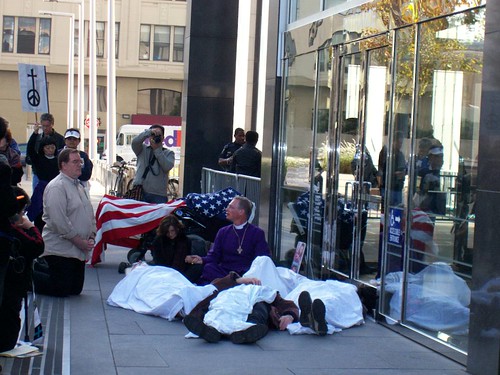
It’s been a busy week. Above is a photograph I took of my bishop, Marc Andrus, on Thursday. I went with a friend from St. Aidan’s to a Eucharist in front of the Federal Building in San Francisco, in remembrance of all who have died in Iraq. About 200 of us processed down the hill from Grace Cathedral. My priest was there, as were a handful of other CDSP students, and my faculty advisor. It was very clearly a Christian service, with some nice interfaith touches. We sang, prayed, heard some of the Beautiful Names for God (read in English, not Arabic) and listened as names of the dead were read to us. Bishop Marc preached a five-minute sermon on the theme that no one dies apart from God. He celebrated the Eucharist, and quietly slipped toward the entrance of the Federal Building, where he and 12 others took part in a die-in. They were arrested for doing so. I am proud of my church, my bishop, and all those who were arrested with him. I don’t see it as a political statement; I see it as focusing awareness of the presence of God in a place that needs healing. I don’t want to be a bishop, but this is a piece of the kind of work I want to do.

I chose not to be arrested, because I’m still in school, don’t have a job, and am a little leery of law enforcement since I was caught in a pepper-spray incident at a protest in Olympia in March 2003. But they handled it really well, here; it was all done with order and respect. If I don’t have to fear for my lungs (I have asthma), I can think about sticking my neck out some.

I’m going to be sticking my neck out in other ways, which excites me tremendously. I met with my rector on Wednesday, and was sent along to the Vocations Committee at my parish. I haven’t gotten to speak with the coordinator yet, so I don’t know exactly what the next steps are. After we’ve spoken, I’ll share what I can; what this means is that I’m moving from being a member of my parish with clear intentions, to being actively and officially in the discernment process.

I feel so affirmed, and so deeply, completely ready. I could have initiated the conversation that led to this months ago, but was flirting back and forth with feeling ready to do it until now. The doubts I still harbor are about my calling, not about myself. (It’s incredibly liberating, just to realize that.) I’ve been through a lot and I’ve come through a lot; I know who God is and I think I know who I am. I want to test and push and experiment. I’m ready to be challenged by a community that will be discerning with me. I want that, even. I’m not afraid of the idea of people knowing who I am, anymore.

A friend affirmed this in the car, the other night, on our way to an Advent liturgy that a group of us is doing in the East Bay. She said, “You’ve done your time. You’re ready to do a different kind of time, now.” She also said she was glad our priest had talked me into realizing that. That wasn’t my take on our conversation; it felt like we were sort of chatting about how everything was going, and I asked the question, “Now what?” We both knew what my intentions were, but I did need to be the one to say them. And I did, and I could, and I’m here. I’m both grounded, and bouncing nearly out of my skin.

This means three important things:

1) I have a spiritual home that I’m safe and happy in;
2) I’m on the right road, and people besides myself can see it;
3) I’m really ready to be open to God, my community, and my own heart.

Alleluia, amen.

Monday, November 27, 2006

Advent/Christmas music

Stolen from Deb...

1. What are your favorite Advent/Christmas hymns?
My absolute favorite is "God on His Birthday"; everything else I love is old and traditional. Others that spring to mind: "O Come, All Ye Faithful," "Good King Wenceslas," and "The angel Gabriel from heaven came...".

2. Which are your least favorite?
I hate, loathe, detest, and despise "Away in a Manger." Always have. Don't care much for "The Little Drummer Boy," either.

3. Which secular seasonal songs make you want to run screaming into traffic?
Most of them. "Santa Claus is Coming to Town" is just plain evil; what idiot decided to enshrine not crying as being "good"? "Rudolph the Red-Nosed Reindeer" irritates me, but it doesn't make me mad. I much prefer old/traditional/religious music at Christmas. New or quirky arrangements are fine; the Miserable Offenders did some really neat stuff, and see below for favorite CDs. Most of the secular winter songs are just cloying, to me.

4. Do you play Christmas music around the house and in the car? What are your favorite holiday CDs?
Yes. My favorites right now are by Bruce Cockburn and John Fahey, respectively. I'm going to try to restrain myself until it actually is Advent, though. (I'm in a folk/gospel/bluegrass groove right now.)

My, I'm blogging a lot. What am I procrastinating from? Don't ask.

Saturday, November 25, 2006

Easy way to donate for AIDS

Click on this post's title, light a virtual candle, and Bristol-Myers Squibb will donate a dollar to the National AIDS Fund. It looks legitimate.

World AIDS day is this Friday. I'll be at my church. If you're in the San Francisco Bay Area, come.

Tod, Lars, I remember you. I pray for my friends who lost hundreds of their loved ones. I pray for all who live with HIV infection, and all who love them. I pray for all who work for education, treatment, and access to both.

Be safe, everyone. And while you're here,visit the UNAIDS website to find out what you can do globally.

Just for fun

The last sentence is very accurate.

What Kind of Reader Are You?
Your Result: Obsessive-Compulsive Bookworm

You're probably in the final stages of a Ph.D. or otherwise finding a way to make your living out of reading. You are one of the literati. Other people's grammatical mistakes make you insane.

Dedicated Reader
Literate Good Citizen
Book Snob
Fad Reader
Non-Reader
What Kind of Reader Are You?
Create Your Own Quiz

Monday, November 20, 2006

Thursday, November 16, 2006

PSA: Supporting Faithful Episcopalians in San Joaquin

"Bishop Schofield of San Joaquin has issued a letter in which he unfolds his plans to leave the Episcopal Church. Part of this plan involves passing various resolutions at the diocesan Annual Convention scheduled to conclude December 2. There is some question as to if these resolutions will pass. If they do, then as of December 3, many in San Joaquin will have officially left the Episcopal Church. It is fairly safe to assume that some of those who leave will also take the keys to the buildings with them, which will most likely result in long legal struggles."

Read the rest from Father Jake.

I don't live there, but a good friend does; the suggestions Jake posted are hers. The diocese covers the Central Valley of California, from east of the coastal mountains to the Nevada border, and from just south of Sacramento to just north of Los Angeles. They need support--emotional, spiritual, financial--to help them build Episcopal communities if the diocese affiliates elsewhere, and to continue in their current ministries if it doesn't. If the diocese does align itself with a more reactionary province, polity will be the least of the changes. The spirituality, culture, and ethos present in the Episcopal Church will be much more difficult to find. In its place will be the homophobia and sexism that are motivating this schism.

The bishop of San Joaquin is one of three remaining Episcopal bishops who does not ordain women. The rest of us have been doing that for 32 years. General Convention decided three years ago to affirm New Hampshire's choice to call a gay man to be their bishop. The bishop of San Joaquin believes that practicing non-heterosexuals are sinners. He is choosing to align himself with an official body that preaches the same.

We believe that God is love. This schism is driven by the desire to exclude. Please help those who may be left without a church that feels like home to them.

Saturday, November 11, 2006

Sustainability, scheduling, and future plans

I went to a Green Festival in San Francisco today. It felt a bit like a giant reunion of food co-op types, only it was incredibly crowded and generally uncomfortable. I had a strange experience.

It was weird for me, because these people used to be my tribe. I was all about organic food and sustainable community. I still believe that way. But, I’m not into the spirituality that often goes with it. I’m not a Goddess-Christian-Buddhist-Pagan anymore. I absolutely believe in interfaith connections, and support them with all my soul. I don’t (and never did) go around with “4:20” patches on my hat. I won’t wear a T-shirt reading, “I believe in God / I just call God Nature.” Eleven years in an interfaith community, and those friendships I still hold onto, gave me an openness that I pray will always be part of me. At the same time, I myself am thoroughly Christian. It felt like there was no space at this festival for people like me.

I need to explore my, and our, options around this. I now have a yoga-practicing, equality-preaching, environmentally-concerned bishop. There is support for sustainability in this diocese. (As there is in the wider church; that’s what the Millennium Development Goals are all about.) When I want faith-driven political action, I start with Sojo.net and go from there. If I want spiritual affirmation of the world I want to live in, without its being tied to any faith, I go to Yes magazine. The only organization I can think of that is dedicated to Christian environmental action is Earth Ministry, a local/regional project based in Seattle. I know there are more; we watched An Inconvenient Truth in the refectory last month. All of these groups need to know about each other. There should be no outsiders at an environmental festival, ever. I wonder what I can do to encourage connections?

I might have a little time to think about that, because I just dropped one of my classes. I’m only going 3/4 time for the rest of this year. I wasn’t keeping up in Modern Church History, even with encouragement to do so. I think I just needed a mental health break. I went full-time last year, and I really struggled to balance giving enough of myself both to academics and to personal growth. Honestly, I think I just need to be happy and not stressed, for awhile. I’m loving Homiletics and Ethics, and Hebrew is the easiest class I have. I’m incredibly happy with my involvement at church, and in our after-school program on Wednesday afternoons. I love the community, and that's mutual. I just want to enjoy all of this and not die, for now anyway.

I talked with my advisor, and my new plan is to do an internship the year after next, rather than to break up my academics. I don’t know yet whether I’ll want to go to school full-time next year, or keep at the current pace. If I go full-time, then I can be academically done after next year. If I continue at a 3/4 pace, I’ll have either one more semester, or a year of half-time work to do. I also want to take classes from the Social Welfare school at Cal, so this all could work out really well. CDSP accepts electives taken at UC Berkeley, if we can integrate our studies there with our vocations. I’d just have to write papers connecting the two. That’s actually fun.

I’ll have to take the Modern Church History—Constructive Theology sequence next year, instead of now. I’m truly okay with that. The work load is really heavy, and I think I’d almost have to take only 3 classes at a time to do them well. I’m excited for next semester; I’m taking Postmodern Christian Education with Sue Singer, whom I know slightly and like very much; an exegesis course on Hebrews, taught by Bill Countryman (very good, and retiring); and a reading course with John Kater on the works of William Stringfellow. (A reading course, for any other Evergreeners reading this, is our version of an individual contract. You and the faculty decide what you’re going to do.) I knew John as a person before this year; he’s a good friend of the Apostle in Exile, and I’m on his regular list of cat-sitters. He’s an incredible teacher, and so obviously loves it. He’s heading off to Asia next year, so I’m learning from him while I can.

In fact, I ought to get some reading done now. I’ve taken quite a bit of this weekend off.

Sunday, November 05, 2006

Homily, Feast of All Saints

I preached this morning at St. Aidan's.

Matthew 5:1-12

Wow. It’s All Saints Day. It’s fall in California!
This is the day when we remember all who came before us.
We praise famous, and not-so-famous, people.
We think about what it means to honor them,
with our lips and in our lives.
People jump into our minds at odd moments,
and we wish them happiness and love.
We send out a quick thank-you for the ones we love,
as we go back to studying or washing the dishes.
We might notice a grandparent in a child’s smile.
We remember, in turn, who we are,
whose we are,
and how we are called to live.

The first record of a feast set aside to commemorate all the saints
dates from before the year 270,
in a work by Gregory the Wonder-Worker, a bishop in Greece.
The date was fixed to November 1 in the eighth century.
This is our way of honoring our ancestors.
We’ve been doing it for a very long time.

What is a saint?
Is it someone who lived a legendarily perfect life,
and died centuries ago in the service of the faith?
Is it someone about whom we tell miracle stories?
Is it the statue under the birdbath in the yard?

The catechism in the Book of Common Prayer says this about sainthood:
“The communion of saints is the whole family of God,
the living and the dead, those whom we love and those whom we hurt,
bound together in Christ by sacrament, prayer, and praise.”

Saints are the faces on the icons,
and the names forgotten centuries ago.
Theirs are the stories we tell once a year on their feast days,
and the stories remembered only by their children.
We are the babies of the family.
Ours is an ancient line of love and faith,
seeking and finding,
wrestling with and celebrating God.

This is a time to honor our own pantheons,
as well as those individuals specifically mentioned by the church.
Not only Aidan, monk, missionary bishop, and generous soul,
but Dymphna—patron of madness and also, for us, of creative chaos,
amazing organizational skills, drag-queen nuns, and children.
Not only Francis, who loved peace, practiced radical poverty,
and kissed a leper on the street—
but all who have lived and died and worked and played
and loved in this city.

I honor friends right here, who have welcomed me, laughed with me,
taught me a new skill, and helped me through a difficult time.
I honor a woman I never knew in the town I came from,
who roused her friends to create a flock of doves out of paper mache,
old sheets, glitter, paint, and glue.
They marched in an annual street fair celebrating life,
the year before she died on Palestinian soil.
I honor her parents, who carry on Rachel’s work
and who have become good friends to me.
I honor a child I cared for when I was just out of college.
She’s a self-conscious thirteen-year-old now;
she no longer jumps into my arms when she sees me.
But she taught me more about joyful assertiveness than anyone has,
before she even turned two.

I honor Mary, the bearer of God, saying yes to wild possibility.
I honor Mary Magdalene, first, vocal, witness to the resurrected Christ.
I honor Thomas, who honored his own need to see and touch the resurrected Christ for himself.
I honor all those who serve the San Francisco Night Ministry,
and who give their time by volunteering anywhere
in the service of God’s people and creation.
I honor those, too numerous to mention, following their faith
with thoughtful abandon,
stepping out bravely and joyfully into new ministries,
serving the God who calls us all to be our true selves.

Who do you honor today? How do they help you hear the call of God?
How do they encourage you to shine your light for others?

Saints are the holy ones, and saints are all of us. What is holiness?

Jesus said,

“Blessed are the poor in spirit, for theirs is the kingdom of heaven.”
Blessed are the ones who are not attached to material things,
or financial security,
for they will find freedom in the generosity of God.
These are the ones who can share what they have,
with others who need even more than they.

“Blessed are those who mourn, for they will be comforted.”
Blessed are those who can feel their true feelings,
who can grieve and cry without shame.
They have the courage to ask for the comfort that they need.
When others need to be held, or rocked, or listened to,
these are the ones who have the strength to give that.

“Blessed are the meek, for they will inherit the earth.”
Blessed are the ones who meet anger not with posturing and threats,
but with openhearted, unreserved love.
These are the ones who can heal the ruptures in this world.

“Blessed are those who hunger and thirst for righteousness, for they will be filled.”
Blessed are those who seek God through working for justice on this earth.
The power of God will be with them
like a mighty stream.

“Blessed are the merciful, for they will receive mercy.”
Blessed are the ones who can reach out with love and offers of forgiveness,
for they too will be loved and forgiven.

“Blessed are the pure in heart, for they will see God.”
Blessed are the ones who are not complicated by greed,
hunger for power,
or any wrong attachments.
These are the ones who can pray in silence.
These are the ones who can be still, in their bodies and souls,
and make space for the love of God to fill them.

“Blessed are the peacemakers, for they will be called children of God.”
Blessed are the ones who work to heal divisions
between all peoples of the earth.
This is the work of shalom to which God calls us;
when we do it, we live into our call to be co-creators of the Kindom.

“Blessed are those who are persecuted for righteousness’ sake, for theirs is the kingdom of heaven.”
God is with us in our hurt and fear and pain,
as much as God is with us in our joy.
God knows our deepest intentions, and God loves us immeasurably.
God “gets” who we are.
In a time when it was physically dangerous
to practice a countercultural faith,
Jesus was assuring his listeners that God was present with them,
even in their suffering.

“Blessed are you when people revile you and persecute you and utter all kinds of evil against you falsely on my account. Rejoice and be glad, for your reward is great in heaven, for in the same way they persecuted the prophets who were before you.”
The work we do here matters.
Our lives matter.
The love of God, shining through us, matters.

Shalom is a Hebrew word that means more than peace;
it means wholeness, completeness, union with one another and with God.
Our new Presiding Bishop, Katharine Jefferts Schori,
preached yesterday on what it means to embody the concept of shalom.
She said,

“The ability of any of us to enjoy shalom depends on the health of our neighbors. If some do not have the opportunity for health or wholeness, then none of us can enjoy true and perfect holiness. The writer of Ephesians implores us to maintain the unity of the Spirit in the bond of peace – to be at one in God's shalom. That is our baptismal task and hope, and unless each of the members of the body enjoys shalom we shall not live as one. That dream of God, that word of God spoken in each one of us at baptism also speaks hope of its realization.”

We are given the work of holiness at baptism,
the very moment at which we enter the communion of saints.
When we do this work,
we affirm the love, the creativity, and the reconciling power of God.

Today we celebrate the Feast of All Saints.
Our cloud of witnesses is right here with us.
Let us do the work that God has created us to do.
Let us be who God has called us to be.
We are the family of God.

Tuesday, October 31, 2006

Happy Halloween!

Friday Five on Tuesday, courtesy RGBP:

1. Do you enjoy a good fright?

Depends. I won't watch horror movies. I love a good scary story, though.

2. Scariest movie you've ever seen:

Aliens. I was 16, and watched it at home from under a blanket.

3. Bobbing for apples: choose one and discuss:a) Nothing scary about that! Good wholesome fun.b) Are you *kidding* me?!? The germs, the germs!

I did it once when I was 8 or so. I didn't enjoy it, mostly because my mouth (yet to experience palate expanders, oh joy) wasn't big enough. I wouldn't do it now, because I don't like immersing my face in cold water. Brrr!

4. Real-life phobia:

Heights, with spiders a close second. ::shiver:: I climbed steps up to a tree house over the weekend, and my hands were sweating on the way back down.

5. Favorite "ghost story":

Easy: the Seattle Underground Tour. Go, if you're up there; it's really fun.

Monday, October 30, 2006

Update, of sorts

Just back from Reading Week. I went to the Apostle in Exile’s house from one Friday to the next, ostensibly to study. I got some work done, but didn’t catch up as much as I’d wanted to. She works during the day, so that was my reading time. We also took her 2½-year-old goddaughter to the pumpkin patch, went to a concert at her church, did projects and hung out at home. It was a good, and restful, week.

I came back to Berkeley for three hours last Friday, and then went off to my parish retreat. We went to the Bishop’s Ranch in Healdsburg. It’s really beautiful there. The theme of the weekend incorporated Scripture, prayer, and “surrounding ourselves with spiritual friends.” I had such a great time. I loved being able to have longer conversations than we can over a Sunday morning coffee hour. We got to sing a lot. The story circle was deeply powerful. And we built our Sunday Eucharist together, in small groups. It came together in a joyful celebration.

My poor blog. I feel like I owe everybody an update; I just haven’t known how to give it. My friend Molly introduced her story last Saturday night by explaining that she’s living in a story she doesn’t know how to tell yet. That’s where I've been, also.

I’ve started updates several times, and didn’t finish them because I couldn’t string the sentences together to say what’s really happening. Since last summer, I’ve been finding pieces of me that I hadn’t known existed. I’m having huge experiences, mostly internal. I want to share them, but I really just need to let myself integrate them first. I also don’t know how to do something so personal, publicly.

For right now, I’m not sure how to use this space. I like the idea of telling stories to illustrate the literal truth; maybe I’ll experiment with that. God knows I don’t really have the time, anyway, even though I want to keep writing. Please bear with me while I figure this out.

Wednesday, October 11, 2006

Job, the Rich Young Ruler, and the Amish Children

Yes, you never hear from me anymore; you just read my homilies. This did not come together as well as the last one, but I think it's still worth posting. I preached it in class yesterday.

The process here was entirely different from the previous one. Before, we each had a different passage from Mark to preach on. Now, four or five of us each week are preaching on the following Sunday's lections. I could have had an easier time if I'd just chosen to preach on Mark. I wanted to do something more challenging, and different. I was not as connected with these texts; but that can hardly be helped, when I got my totem text on the very first try. I was looking for parallels, and I explored midrash (without knowing that name) looking for them. Someone said she wanted actual interaction between Job and the man in Mark; I like that idea, and it would be something to think about playing with later. This, like the last one, came together right before I had to give it.

I felt mildly heretical in a couple of ways; our instructor advises us to choose one lection, and we had a discussion before about how outside poems may or may not work. I used one anyway, and I probably would again, though I'd think about it more deeply.

I'm working very hard on vocal presence and delivery. I'm realizing how powerful and how important it is to bring what's inside of me out, through more ways than writing. I didn't feel as grounded in my body as I'd wanted to; part of that was nervousness in front of a video camera. Vocally, though, I'm getting it. That feels really good.


Job 23:1-9, 16-17
Mark 10:17-31

Have you ever wanted something you couldn’t have? Have you ever had everything you could have wanted, and lost it in an instant?

If God completely blew your mind about the whole idea of having or being enough, what would you do?

Today, we hear two answers to these questions. We meet a man, in the gospel of Mark, who cannot separate himself from his things. And we witness Job, who has lost everything in one stroke, and who cannot bear the thought of losing God.

We know the man as the “rich young ruler,” but that is a conflation of all three Gospel stories. Luke calls him a ruler; Matthew says he’s young. In this earlier account, he owns many things, but speaks of his youth in the past tense.

We meet him running after Jesus, on a journey we know not where. This story directly follows Jesus’ encounter with the children; perhaps the man had heard him tell the disciples to let the children come, and that the Kingdom of God belonged to them. Perhaps he heard them laugh; he saw a joy there that he distantly remembered. He’s grown now; he is weighted down with adult concerns. Perhaps he saw Jesus smile.

Whatever this man knows of Jesus and his movement, he sees something here that he wants. He chases Jesus and stops him on the road, asking how he can get that too. Jesus challenges him, first asking for the flattery to stop and then pushing him to think past the conventions that he already knows.

“Yes,” the man agrees, “I’ve followed the law from my youth.”
Jesus looks into him, with love.

“Yes, you have, but can you leave your wealth behind?”
“Can you sell off everything that establishes your identity in this world, and give to the ones who need it?”

One commentator reminds us that pious men were expected to prosper, as a sign that their religious observance granted them favor with God. These men then could be benefactors for others, giving at their discretion to people in need. The recipients would then of course be grateful, and the wealthy donors would have good reputations. In a class-bound society, their status would increase.

Jesus is saying, “Give all of that up. This is not about how the world sees you. The path to God is not about earthly privilege. This is about true freedom. This is about the capacity of your love.”

The man cannot do it. He can’t let go of his status, his wealth, his security. He sees in Jesus true assurance, true joy. He wants that, but he can’t let go enough to receive it. He goes away sad.

Jesus knows what he’s asked of the man, and he understands why it’s hard. Money talks. How you dress and what you own tells other people who you are. It tells them how to treat you. It tells you how to treat them.

God’s economy runs on completely different principles. God asks different questions.

How clear can your heart be?
How loving can you be?
Can you give up everything you hold on to, to follow me?
Do you know that I love you?
Do you know that the little, unencumbered, vulnerable, free child in you is enough?

I don’t think the man ever would have forgotten this conversation. He had looked in the eyes of pure love, and said no. But that experience would not have left him.

I wonder, as the preacher from Galilee became stories whispered over campfires, as the occupation tightened, as the man’s fortunes changed, did these words of Jesus roll around in his head? Did he fall asleep praying for understanding? Did he still see those eyes in his dreams at night?

As the siege began and the temple burned, and with it everything that a good, observant, faithful man never questioned, I wonder if Job would have had an answer for him.

Job is not an Israelite; he lives in another land and his name comes from the wider area. He is introduced in the first chapter as a man who has always striven after God, and always been astoundingly successful. He is “blameless, upright, one who feared God and turned away from evil.” He is scrupulously observant, and staggeringly wealthy. It is said that Job is the greatest of all the people of the east. At a time when material wealth was a clear sign of divine favor, Job is sitting happily in God’s lap, a shining example of all that is good.

Until the day Satan pokes God in the ribs. Satan happens by one day, out for a long walk hither and yon around the earth. God seizes the chance to brag on Job. Satan says, “well of course he’s faithful; he’s never been tested.”

“Oh,” says God. “Well, then, have at him.”
The next thing Job knows, four messengers have told him that his animals have been stolen or slaughtered, his servants killed by fire and violence, and a house has fallen on all of his children. His wealth has vanished, and his children are dead.

Job’s world has been destroyed in an instant.

Job responds with a natural grief. He tears his clothes, shaves his head…

and falls on the ground and worships.

God watches, knowing that he has allowed Job to be destroyed for no reason. Satan challenges God again, and Job loses his health. He continues to be faithful.

Today’s passage is in context of a long conversation. Three of Job’s friends had heard what happened to him. They came to comfort, console, and challenge him: how could such awful events happen to a righteous man?

What must Job have done to deserve this?

Job knows that he has done nothing. In answer to his friend’s accusation, Job protests. He still doesn’t know of the arrangement God has made with Satan. He doesn’t know why he is suffering. But he is sure that if he could find God, he could get God to listen. He would plead his case before God, and God would answer him. Job wants to understand.

But Job cannot find God, though he looks everywhere. And that, paired with the knowledge that God will do whatever God chooses, terrifies Job. He desperately seeks an audience with God. He also desperately wants to hide.

But he doesn’t.

Job grieves his lost connection with God. But he does not doubt that God still is there. When his life gets difficult, he doesn’t understand. He loses his rootedness. But he stays in the soil. He stays in the struggle. He stays in the conversation.

The man in Mark thought that giving up all of his things was impossible. He walked away defeated. Job has had everything taken from him. He is living in the impossible place. He screams and shouts and rails against it. But he stays present. All his life he has lived in communion with God. He wants that back. If he has to fight for it, he will.

A week ago yesterday, a man walked into an Amish one-room schoolhouse in Nickel Mines, PA. He sent the fifteen boys out of the building, along with four adults and their infant children. He shot all ten of the girls. Five of those girls died. The oldest was 13; the youngest was 7. Another girl, six years old, is not expected to survive.

The man also killed himself. He leaves a wife and three young children.

The man had lost a newborn daughter nine years ago. He was clearly disturbed for other reasons as well. He was angry at God, and confused, and distraught. He took out his rage on these children.

This man was buried yesterday. About 75 people came to his memorial. About half of them were Amish.

There’s a poem by the 13th century Sufi poet, Rumi, that helps me understand their compassion, their will to forgive, and their commitment to stay faithful to God. He writes,

Come, come, whoever you are,
Wanderer, worshiper, lover of leaving,
Ours is not a caravan of despair.

Come, come, whoever you are,
Even though you’ve broken your vows a thousand times,
Come, yet again,
Come.

We are about to celebrate the Eucharist. We are about to enter with our bodies into communion with God.

If you are happy and content with your life, come.
If you have a good and quiet conscience, come.
If something wonderful just happened, come.
If you are hiding a grief that consumes you, come.
If God is asking you to do something difficult, come.
If God is asking you to do something impossible, come.
If you’ve got four things due before Reading Week and you haven’t started any of them, come.
If you are angry with your mother or your child or your partner or your best friend, come.
If you are angry with God, come.

God calls all of us into struggle, into life, into conversation, into communion. All are welcome at the table of the Lord.

Tuesday, September 26, 2006

The Woman with the Alabaster Jar

Yes, I know, my blog needs a real update. I'll try to get to that in the next day or so. For now, here is the homily I preached in class this morning. It's my first, before my peers. We picked passages from Mark on strips of paper our instructor held out to us; I seem to choose or be chosen for the ones I need most.

We are "pretending" to preach in a Eucharistic context, which explains a bit toward the end.


Mark 14:1-9

What is going on in this house? Who is this woman? How has she managed to scandalize everyone? And what can we make of Jesus’ answer?

What are we supposed to do with this story?

We come upon this dinner party in what we know will be the last week of Jesus’ life. Mark has set the scene just previously, with apocalyptic prophecies, warnings to be watchful, and a note that the Passover is two days away. Jesus is wanted by the Temple authorities. There is not even a pause between this story and the next, when Judas betrays Jesus. In our minds, we fast-forward to Friday. Jesus is doing the same.

Whom do we meet here? We are in Bethany, which strikes me as iconic because one of its Hebrew meanings is “house of the poor.” We see Jesus, at a dinner party at the home of an outcast, a man with a disease that marked him with a giant Quarantine sign. He is not alone; there are friends and family there with him. And here is a woman, appearing silently out of nowhere to pour oil over Jesus’ head. To the shock of everyone around him, Jesus doesn’t seem fazed by this. Instead, he castigates the others for mixing up their priorities.

We aren’t told her name. The writer of John identifies her as Martha’s sister Mary. The author of Luke considers her a prostitute, who not only anoints Jesus but weeps over him, and dries his feet with her hair. Mark, the first written gospel account, gives us the bare bones that others built from. She is simply a woman, who somehow came by a jar of ointment worth nearly a year’s wages. She breaks it open, and anoints Jesus’ head, as if he were truly a king.

She doesn’t just dribble a little. She pours it all out over him.

Picture this: A houseful of men are gathered, in occupied Jewish Palestine, two days before the festival celebrating their people’s deliverance from Egypt. They’re just sitting down to dinner. We don’t know who all is there. We don’t know how many. One commentator assumes an all-male gathering. We don’t know if Jesus brought the usual crew or if he showed up alone. We can guess that no one there came from any particular means; they would have risked too much by hanging out with a leper. We don’t know what they’re eating or drinking, or how much. We don’t know if they’re quietly or urgently making plans for liberation, or if they just want to have some fun before the craziness happens. There’s the potential for anything, here.

Suddenly, silently, she slips in, carrying a jar that cost a year’s daily wages. She carries it in front of her, with both hands, careful not to drop it. She knew what she was doing. She knew what she was risking. She locks her eyes on Jesus, breathes deeply, and slowly and with purpose, walks toward him.

There’s a rustling of elbows, a collective cough. She sets her jaw, and tunes them out. She grips the jar tighter, to keep her hands from shaking. She walks on, focused on what she came here to do.

Someone shouts, “Hey! Simon! Where did she get THAT?”

Simon shrugs back. They stop what they’re doing and watch. All eyes are on her now.

She reaches Jesus. He bows his head, so she can reach. She breaks the jar, pours it over him, and… instant apoplexy. Eyes popping out all over the place. There is oil everywhere, all over Jesus and running on the floor. Everyone in Judea can smell what it is.

There is one long indignant silence.

Then people start shouting. Where did you get that money? Why did you buy that jar? Don’t you care that people are starving? Why on earth did you pour that all over his head?

Maybe, who on earth are you? Who let you in here?

Definitely, what on earth just happened?

Jesus, somewhat used to calming storms, quiets this one. Sharply. “Leave her alone!”

Umm…what?

“Yes, you. You were talking about the coming of the Kingdom. She just did something that mattered. You will have poor people, always, around you. You can care for them whenever you want. This woman—yes, this one right here—has anointed my head for burial. She has done a holy thing.”

I can hear them all just muttering, “oh.”

These are not shady characters. They’re thinking outside of themselves, already—they want to share what they have. They’re a bunch of people gathered in a house with Jesus, whom the Markan community knows as a tireless healer, teacher, and prophet with a pressing sense of urgency. Wherever Jesus is, things happen, and the kingdom of heaven is always breaking through. There is an energy always crackling around him. They are preparing for the great festival of liberation. They’ve got their minds on change.

Jesus doesn’t condemn them for that. He doesn’t tell them not to serve the poor. He takes for granted that they will do that anyway. He tells them that they have to do both. Sharing with people who have less than you is one way of loving God.

Seeing the need in one person, and filling that, is another.

Jesus often stands up for women. Why this one? It wasn’t she who gave her last penny to voracious Temple authorities. She did nothing like lose a quarter and search her whole house for it. She neither asks for healing, nor argues with him on behalf of someone she loves. She walks into this house without speaking a word, and she pours an entire jar of oil over Jesus’ head.

Nard is a member of the valerian family; it’s similar to what gives us Valium. It was imported from India, and was used both for healing and for anointing the dead. What she did, in her way, was to give healing to the healer.

She is told she’ll be remembered—but we don’t even know her name. Perhaps she is a member of Simon’s household. Perhaps she’s a perfect stranger here. We aren’t told how she got the money to pay for the ointment. The point isn’t how she paid for this. The point is that she held something precious, and she gave it away. She looked into Jesus, and she saw a king. She saw what he needed, and she did it for him.

She walked past all of these men, and she gave herself away.

If you look around, you can see people giving their whole selves for the healing of the world. Ten years ago, I met a man in downtown Olympia. He was sitting at a table in front of a magazine store I used to hang out in. He said hi. I said hi back. And I’m not sure why, but I sat at the table with him.

We got talking. He told me that he’d just gotten out of jail. He did time for something drug-related; I don’t remember what it was. He had just landed in Olympia, and was trying to figure out how to make a life there.

In the years since, he finished college and got involved in the local activist community. I know his last name, but I’ve never heard him use it. Everyone in town calls him “Long-Hair David.” He got involved with a program called “Books to Prisoners,” and brought it to town. There’s a regular thing now, where people bring books that they’re done with to a drop-off location, and volunteers package and mail them to inmates all over the US. He helped start a local harm-reduction program, and got the county health department to back him. He started a program offering donations of blankets and other essential items to local homeless youth. Many fall and winter evenings, you can see him on his bicycle, trailer packed with things to give away.

A year ago, I came to Berkeley with a question. When I trained to volunteer at a domestic violence/rape relief agency, we played a game on the last day of training. The instructors got us all together in a circle, and asked us this:

“How do you want to love the world?”

We were quiet for a minute, and then we played the game. One would ask the question, and throw a ball of yarn to another. That one would speak her answer, hold the string, and toss the ball to someone else. We repeated this until we had a spider’s web of connections, speaking who we were and what was in us to give.

I don’t remember what I said then. But I ask it again, now. Probably we all do. God has called us into a time of study and questioning, a time of learning and preparation for lives of intentional service. Sometimes we are absolutely clear about our passions and our callings. We’re off organizing for immigrants’ rights, or creating liturgies for peace. Sometimes we’re drowning in paper and deadlines, and can’t think past the next cup of coffee.

As we come to this Eucharistic table, let us remember who we are. Jesus saw the woman’s worth. Like her, we all are worth the love we have inside us. Our world is worth the love we have to give it.

Let us eat this bread, drink this cup, and with all the love we are given, give ourselves away.