Thursday, May 13, 2010

In search of a functioning car

My 17-year-old Voyager is facing major repairs, and possibly the end of its life. I am in search of leads for another car, preferably a long-term loan or outright donation to me. It doesn’t have to have been manufactured in this century; all I require is that it not threaten to strand me on the freeway. I'm equally comfortable with a stick or automatic.

I’m immersed in ministry with the homeless. I’m learning about the field, how I want to do this work, and the whole process of applying for grants to fund myself. I’m committed to this path, and am physically healthy and able again after cancer and chemo. It’s been a long road to get here.

I live about an hour from everything I do. I make that drive several times a week. I do have friends I occasionally stay with, but right now it's difficult to get there. I’m planning to move closer when I’m economically ready. (I'd take the bus, but different counties have different systems, and they don't connect.)

If you live in Northern California (or farther away and you'd like to visit), might you know of anyone who isn’t driving anymore, or who has a car they’re not using? Do you know of anything (very) cheap and reliable?

Thank you for anything you can think of!

Sunday, April 25, 2010

Living into resurrection

I posted this as my Facebook status this morning:

Today is my Easter. Two years ago, I was diagnosed with cancer. I am healthy, and whole, and alive. I am grateful for everyone who walked with me through that time, and still. Every day is resurrection.

I remember that phone call—but now it feels like forever ago. So much has changed. I finished school, finished chemo, am out in the world now (rejoicing in the power of the Spirit!). I’m in a community now, which didn’t know me then. I’m beginning to do the work I was created to do.

What I learned then, is what I know now. The cure was medical. What truly healed me, what continues to heal me, is love.

I had to go to that horrible, fearful place—I had to be more afraid than I’d ever been, of a real mortal threat—to open myself up enough to the love around me, in my friends and in God. What I found, made it once and forever okay to be exactly the person I am.

I stood up in church today and said, I have two Easters. People understood. I got so many hugs afterwards—not out of pity for having been sick, but rejoicing in this cherished life. They know what cancer looks like; some who reached for me were survivors. And they see me here, healthy, alive, and claiming resurrection. Our deacon thanked me for bearing witness; she said that there are people here now who are going through it. No doubt. And I’m very aware of how lucky I am (I don’t say blessed, in this instance) that we caught it when we did.

I had two conversations today; one with a friend who is living through something far more horrifying than a cancer diagnosis, another who has gone through similar transformations but with a different cause. We bore witness to each other, the truth our lives have taught us: Love heals.

It sounds simple. And it is, but it isn’t. I keep talking about it, partly because I’m still processing all of this and learning how to carry the blessings of that time (love, freedom, knowing what’s important, healing), into this current life. And I know that I bear a responsibility to share the story I have lived. You can die and be resurrected. We are as strong, as faithful, as loving, as open, as we will need to be.

I remember the voice that spoke to me, two years minus a few days ago, while I was walking by myself through the Cal campus: “If you’re open to this, you can learn from it.” I clung to that for all I was worth. That is why I will tell you, cancer healed me.

Christ is in every one of us. Always. We have what we will need.

Alleluia, amen.


(Thank you to Cantus Mundi for the music.)

Thursday, April 22, 2010

John Muir and Hudson Stuck

Preached at the 5:45 service.

Feast of Muir and Stuck
Luke 8:22-25

Happy Earth Day!

Today we honor John Muir
and Hudson Stuck, environmentalists.
One became a natural theologian;
the other an Episcopal priest.
Both sought adventure in wild places;
both fell in love with God’s creation in the mountains.

Muir was born in Scotland in 1838.
At age 11, he emigrated with his family
to a farm in Wisconsin.
His father was strictly religious.
One factor in their emigration
was to get away from the Church of Scotland;
it was too liberal for the elder Mr. Muir.
John and his brothers and sisters
were made to read the Bible daily in childhood.
He memorized most of the scriptures.

He took classes in geology and botany
at the University of Wisconsin,
but never graduated.
He went to Canada in 1864,
possibly to avoid the Civil War draft,
and returned to the US in 1866.
Muir worked as an industrial engineer in Indianapolis,
until an accident changed the course of his life.
A tool he was using slipped and struck him in the eye.
He was confined to a dark room for six weeks,
not knowing whether he would see again.
When he did, he saw the world,
and his purpose, as if for the first time.
Muir wrote of this resurrection experience,

“This affliction has driven me to the sweet fields. God has to nearly kill us sometimes, to teach us lessons.”

From that point on,
he determined to follow his own dream
of exploration and study of plants.

In September 1867,
Muir walked 1,000 miles from Indiana to Florida.
He had no specific itinerary,
except to go by the "wildest, leafiest, and least trodden way [he] could find."
After contracting malaria on the Gulf Coast,
he abandoned his plans to go to South America.
He set out for California instead.

Muir landed in San Francisco.
He visited Yosemite for a week,
and fell in love with it.
The mountains opened up a sacramental awareness in him.
He wrote,

“We are now in the mountains and they are in us, kindling enthusiasm, making every nerve quiver, filling every pore and cell of us. No temple made with hands can compare with Yosemite... The grandest of all special temples of Nature.”

When he returned,
he built a cabin over a stream,
so he could listen to the water.
He lived there for years.

Muir threw himself into the preservation of Yosemite Valley,
and fought for it to become a national park.
In 1903, Teddy Roosevelt accompanied him on a visit to Yosemite.
On the way there,
Muir told the president
about state mismanagement of the valley
and exploitation of the valley's resources.
Even before they arrived,
he was able to convince Roosevelt
that the best way to protect the valley
was through federal control.

Muir shed the restrictive practices of his father’s faith,
but his awareness of the love of God
grew to include all of nature.
He developed a core belief that "wild is superior."
He came to believe that God was always active
in the creation of life
and thereby kept the natural order of the world.
In Travels in Alaska, he wrote,

“Every particle of rock or water or air has God by its side leading it the way it should go; the clearest way into the Universe is through a forest wilderness; in God's wildness is the hope of the world.”

During his lifetime John Muir published
over 300 articles and 12 books.
(He hated writing, but he made himself do it.)
He co-founded the Sierra Club,
which helped establish a number of national parks after he died,
and today has over 1.3 million members.
Muir has been called the “patron saint of the American wilderness”
and its "archetypal free spirit."

Hudson Stuck was a priest and environmentalist.
He was born in London in 1863,
and educated at King’s College.
In 1885, he tossed a coin:
heads for Australia; tails for Texas.
It came up tails,
and he went to work as a cowboy and a schoolteacher
before entering seminary at Sewanee in 1889.
He was ordained in 1892,
and after four years
became dean of St. Matthew’s Cathedral in Dallas.
There, he became a social reformer.

His sermons and newspaper articles
raised every conceivable issue
from lynching and gun control
to the need for recreational areas.
He founded a night school for millworkers,
a home for poor women,
and St. Matthew's Children’s Home.
Stuck was instrumental in having
one of Texas’ first child labor laws passed, in 1903.

He was happy in Dallas, but restless,
and he moved to Alaska in 1904.
As the archdeacon of the Yukon and the Arctic
he administered 250,000 square miles in the interior of Alaska.
Traveling by dogsled in winter and boat in summer,
Stuck ministered to miners and loggers,
and defended the rights of Native Alaskans.
In 1913, he organized and led
the first successful complete ascent of Mount McKinley.
He died of bronchial pneumonia at Fort Yukon, Alaska,
in 1920.

The gospel connections were hard for me to find,
at first reading.
It’s a lovely story:
Jesus is in a boat with his disciples;
a storm comes up and they get scared,
and he calms the storm for them.
But it would be easy to make the wrong interpretation.
This isn’t about controlling the weather.
It isn’t about being the boss of nature.
And it’s not saying that natural disasters won’t happen if you have faith.

What does Jesus have in common
with these two mountaineers?
What are all three of them doing?

Jesus is in a boat with his disciples.
A storm blows in.
The boat fills with water,
even as he sleeps through it.
The disciples panic, and they wake him up.
He speaks to the wind and the waves,
and the storm dissipates.

John Muir fell in love with nature.
He fought to get Yosemite Valley federally protected.
He lost the battle for Hetch Hetchy,
and grief over that nearly broke him.
He used the power of the written word
to communicate this love for the natural world.
And once you share in this love for creation,
you share in the work to protect it.

Hudson Stuck was a social reformer before he ever climbed a mountain.
He advocated for millworkers, women, and children
before moving to Alaska
and doing the same for the Inuit people.

They are all advocating.
They’re using the powers that they have,
to speak up for people and places
who can’t speak up for themselves.

“Storm, be still.”
“Mr. President, protect this valley.”
“State of Texas, stop exploiting your children.”

They are all working in love, for love.
This is God’s call to us.

Today is Earth Day. What can we do right now?

Recycle. Create less trash to begin with:
consider the amount of packaging when you buy things.
Join or start a community garden. Feed your own neighborhood.
Give what you don’t use, to a food bank.
Eat local food.
Reduce the amount of fuel consumed
in getting your vegetables to your table.
Take shorter showers. Save water.
Turn out the lights when you leave a room.
Walk, ride your bike or take public transit instead of driving.

Get involved with TREE,
Trinity Respecting Earth and Environment.
I asked Tina to tell me more about them,
because I really didn’t know.
She sent me last year’s annual report.
They got recycling going here.
They applied for and got a bike rack from the city.
They took environmental field trips.
They sold stainless steel water bottles and solar cookers,
like at last Sunday’s Earth Day fair.

TREE meets on the fourth Wednesday of the month,
at 6:30 pm in the upstairs conference room.
Go see what you can do for the earth.

I will close with a piece from John Muir, from My First Summer in the Sierra:

When we try to pick out anything by itself,
we find it hitched to everything else in the universe.
One fancies a heart like our own must be beating in every crystal and cell,
and we feel like stopping to speak to the plants and animals
as friendly fellow-mountaineers.
Nature as a poet, an enthusiastic workingman,
becomes more and more visible
the farther and higher we go;
for the mountains are fountains—
beginning places,
however related to sources beyond mortal ken.

Amen.

Saturday, April 03, 2010

Holy Saturday

I am reaffirming my baptism at the Vigil tonight.  There are many, many reasons for wanting to do it particularly now. After cancer, every day is resurrection. I know that my actions within the homeless community claim my identity as a baptized person of God; I need to do it ritually, as well. And I’ve been wanting to do it since I came back to the church—before I thought of seminary; before I was sick. I’ve been going to the Catechumenate on Thursday nights, since I organize Thursday community dinners. (We feed homeless and church people, at the same tables, together.) I go because I enjoy the practice, and the conversation.

One of our priests mentioned reaffirmation a few weeks ago; she said that anyone could do it at any point. That was all the permission I needed. So I told her, wrote my name in the book, and here we are.

Because I’m reaffirming, I went to the Holy Saturday liturgy this morning.  I'd never been to one.  All of us candidates for anything (baptism, confirmation, reception, reaffirmation) were called up front for an Ephatha rite.  This same priest anointed each of us, may our ears and our mouths be opened.

She came to me... and put her fingers directly below my left ear, on my cancer scar.  It felt all sparkly. The nerves aren't normal from the surgery yet, and there was power in her touch. I knew she was saying, "May your ears be opened so you can hear the words of Jesus."  But all I could hear was, "Be transformed for the whole world."

I told her about it afterward.  She knows the cancer story, though I met her after it was done.  She knows why this touch was holy.  But that anointing wasn't her intention.  It was God's.

Amen.

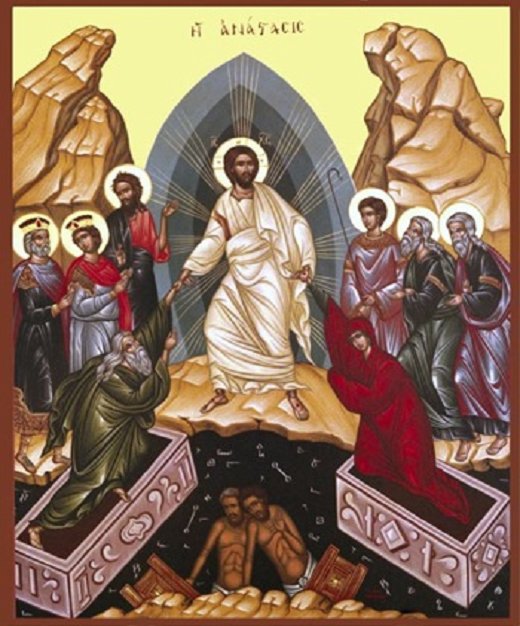
Ikon: The Harrowing of Hell


Down through the tomb's inward arch
He has shouldered out into Limbo
to gather them, dazed, from dreamless slumber:
the merciful dead, the prophets,
the innocents just His own age and those
unnumbered others waiting here
unaware, in an endless void He is ending
now, stooping to tug at their hands,
to pull them from their sarcophagi,
dazzled, almost unwilling. Didmas,
neighbor in death, Golgotha dust
still streaked on the dried sweat of his body
no one had washed and anointed, is here,
for sequence is not known in Limbo;
the promise, given from cross to cross
at noon, arches beyond sunset and dawn.
All these He will swiftly lead
to the Paradise road: they are safe.
That done, there must take place that struggle
no human presumes to picture:
living, dying, descending to rescue the just
from shadow, were lesser travails
than this: to break
through earth and stone of the faithless world
back to the cold sepulchre, tearstained
stifling shroud; to break from them
back into breath and heartbeat, and walk
the world again, closed into days and weeks again,
wounds of His anguish open, and Spirit
streaming through every cell of flesh
so that if mortal sight could bear
to perceive it, it would be seen
His mortal flesh was lit from within, now,
and aching for home. He must return,
first, in Divine patience, and know
hunger again, and give
to humble friends the joy
of giving Him food--fish and a honeycomb.

--Denise Levertov

Sunday, March 21, 2010

Lent V

John 12:1-8
Lent 5

“You always have the poor with you, but you do not always have me.”

WHAT?!

Could Jesus have said anything more jarring?
Our community gives a lot to the Safe Ground movement.
I help coordinate Trinity’s response to their needs. 
I know some of these people whose portraits look out at us. 
And I know that every other time Jesus spoke of poor people,
it was to bless them
and to love them.

And I know how willingly this community responds. 
I’m here on shelter nights. 
I know how gladly people give of themselves,
their time, their energy.

Jesus’ words here feel like a slap. 
They go against everything else he ever said. 
They fly in the face of his tradition. 
No self-respecting Hebrew prophet would ever say anything like that. 
And Jesus knew it.

That’s because money isn’t the point. 
Look at the rest of this scene.

We’re in the home of Mary, Martha, and Lazarus. 
Mary, the contemplative. 
The one who would rather sit at Jesus’ feet,
and take him in with her eyes and her heart,
than do anything else in the world. 
Martha, always responsible
for making the household run smoothly.
Always busy, bustling around.

Lazarus.  Brother to Mary and Martha. 
Friend to Jesus,
like a brother to him as well. 
Lazarus, whose death made Jesus weep,
and whom he had raised from the dead
sometime shortly before. 
The author of John writes
that the raising of Lazarus had caused the Temple authorities
to conspire to kill Jesus. 
Jesus knew he was in danger;
he “no longer walked about openly.” 
Mary and Martha and Lazarus knew it too.
The air was electric with danger,
heavy with the smell of impending death.

Lazarus was at the table. 
But it’s hard for me to imagine that he ate. 
He had been dead. 
And he walked the earth again.
Don't bother asking, how does that happen? 
It doesn’t.  But it did. 
I picture him doing what I imagine I would do...
just staring. 
Having to be pulled out of himself,
when the others laughed at some mundane joke. 
Unable to walk in both worlds at once. 
Still stumbling sometimes,
as if his legs and feet were still bound. 
Trailing rags behind him,
in his mind if not his body. 
When I was detoxing from chemotherapy,
I would break out into cold sweats.
No one else could smell it on me,
but I could.
Lazarus could still smell the sickness
that killed him.
He could still smell the sourness of death.

Mary is the quiet sister. 
The one who understands without being taught. 
Who always infuriates Martha,
because she leaves Martha all the work. 
Mary gets it right, again.

Mary knows how to respond
to God in her living room. 
She kneels on the floor,
breaks the jar of perfume,
and pours it over Jesus’ feet. 
Just like that. 
She moves without speaking. 
She’s silent, slow, purposeful. 
She does not ask permission. 
She doesn’t explain herself in words. 
She doesn’t need to. 
Jesus understands what Mary is doing. 
He translates for the others: 
“She bought it so that she might keep it for the day of my burial.”

This household knows the smell of death. 
Lazarus had been in the tomb four days. 
Martha had begged Jesus not to roll away the stone.
She knew the smell would overpower them.
Jesus yelled in the face of death,
and Lazarus walked out alive.

The jar of perfume that Mary broke
held about a pound of scented oil.
That's at least a couple of good double-handfuls.
She doesn't anoint his head,
like you would do for a king
or somebody important.
She anoints his feet.
While Jesus is still living,
Mary prepares his body for burial.

She held Jesus' feet,
and she poured the oil over them.
The scent—somewhere between mint and ginseng—
exploded into the house.
The oil ran over Jesus' toes, down his ankles,
all over Mary's sleeves,
and onto the floor.
The house smelled like burial spices,
like grief, and like love,
for a long time.
Mary rubs the oil into Jesus' skin.
She wipes him dry, with her hair.

Judas sets up the point that Jesus is making.
He asks a perfectly legitimate question,
“Why was this money not given to the poor?”
Really, it was not a small amount.
Three hundred denarii would feed a family for a year.

Jesus doesn't say, don't take care of the poor.
He says only, not right now.
He says, Mary knows what you're not seeing.
Let her care for me.
He knows the law full well, and he honors God in his response.
He's quoting Deuteronomy 15:11.
The full text of the verse he alludes to is this:

“Since there will never cease to be some in need on the earth, I therefore command you, Open your heart to the poor and needy neighbor in your land.”

He's saying, While I am here in front of you, love me.
Focus first on the love that drives you,
that gives you life,
that is the reason for everything you do.
When I am gone,
you will be able to love me
by loving the poor, the homeless, and the needy.

Love extravagantly. 
Love with all you are.
The poor you always have with you—
their faces are here with us, on these walls. 
We have sheltered Carol and Barbara. 
I’ve heard stories of some of the others. 
Love these people whose portraits you see. 

Family Promise starts tonight. 
Go see if there are still times you can sign up. 
Cook dinner for our guests. 
Play games with the kids. 
Help them with their homework. 
Stay the night.

Jesus doesn't literally knock on our door
and sit at our dinner table.
We cannot serve him directly in the way that Mary did. 
But we can do what he commanded us to do. 
We can love one another, as God has loved us.
The presence of Christ lives in everyone. 
Love the people who show you to yourself. 

We have enough love. 
God has broken that jar, over us,
and given us each jars to break.
It's running over us right now,
in our hair, soaked in our skin,
dripping onto the floor.
Like Mary, pour it out without counting the cost.
Give it away. 

Thursday, February 25, 2010

John Roberts, Priest

Deuteronomy 31:30–32:4, 6b-12a
John 7:37-41a

Today we honor the memory of John Roberts.
Who was he? What is his story?

John Roberts was an adventurous soul.
He was born on a farm in Wales in 1853.
He was educated at a college that was affiliated with Oxford,
and left Wales for the Bahamas in 1878.
He was ordained to the priesthood there.

Roberts was chaplain of St. Matthew’s Cathedral in Nassau,
and he also worked in leper colonies.

After two years in the Bahamas, Roberts sailed to the US.
He asked the bishop of Wyoming and Colorado for
missionary work in his most difficult field.
Bishop James Spalding gave it to him,
at the Wind River Indian Reservation
in the mountains of Wyoming.

In February, 1883,
Roberts literally hitched a ride
from Colorado to Wyoming
on a jury-rigged mail wagon,
in a blizzard.

He served two tribes on the reservation:
the Eastern Shoshone people and the Arapaho.
He set about learning all he could about both tribes’ customs and beliefs,
believing that he could be more effective
if he knew and respected the people he wanted to minister to.
He also learned the Arapaho and Shoshone languages.
He eventually translated the gospel.

Roberts often said that his goal
was to help the Native Americans to be self supporting.
With this in mind,
he established two schools for Native children.
He earned the trust of the tribal leadership
and was often involved in their negotiations
with federal agents.
He dealt fairly with the people.
In turn, they called this white, European priest, “Elder Brother.”

A friend remarked this morning,
how odd it seemed to commemorate a man
for treating people fairly.
She was right.
But I’m struck by someone crossing the ocean
to purposely, consciously, and repeatedly
share God’s love and justice
with a forgotten and shoved-aside people.

Roberts lived into his call
as a priest of the high mountains,
the forgotten people,
the dry and desolate places.

We entered Lent with the image of Jesus in the wilderness.
He went there to fast, pray,
and be as transparent as he could to the will of God
speaking louder and louder,
to him and through him.

John Roberts went to the wilderness to seek and serve Christ in all people.

The compelling image running through both the Old Testament reading
and the Gospel for tonight
is the picture of water in the desert.

Moses prays,
“May my teaching drop like the rain,
my speech condense like the dew;
like gentle rain on grass,
like showers on new growth.
For I will proclaim the name of the Lord;
ascribe greatness to our God!”

He’s saying, My people, you are so thirsty.
Let my words transform and heal you.
God is your water. God is your rock.
There are no others.
There is no one else who can sustain you.

Jesus calls to the people,
“Let anyone who is thirsty come to me, and let the one who believes in me drink. As the scripture has said, ‘Out of the believer’s heart shall flow rivers of living water.’”

God is your water.
The water of life flows within you,
and out from you,
and all around you.
Hear my words, and let them heal you.
Drink deeply.
Soothe your thirst.
Let the river flow from you,
for other thirsty people.

What is wilderness?
I think of the canoe camping trips in the Cascade Mountains
that I took as a kid in Girl Scouts.
Cold glacial rivers, high volcanic peaks.
Tying our food up in a tree, away from bears.
No people,
other than our own pack of sunburned teen-agers,
and the college students who supposedly
were responsible for us.
You might think of Yosemite,
or wherever else you go when you want to get away.

We go to the wilderness because it is beautiful.
We go, to get out of the city.
We go because it’s fun.

Jesus went to the wilderness to uncover himself.
John Roberts went there to serve disenfranchised people,
in Christ’s name.
Jesus became water in the desert.
John Roberts brought that water,
as respect, love, and justice for God’s children
that humankind wanted to forget.

The wilderness that Roberts crossed an ocean to find,
is never really out of our vision.
We may not literally go to a reservation.
We don’t have to.
But neither do you have to find it
among the homeless people in Friendship Park,
or in our own Great Hall on a night
when we are hosting Safe Ground.
(Though if you feel called to this ministry,
please come.)
The wilderness is everywhere that people are
forgotten, hurting, lonely, or afraid.
We all react more strongly than we should,
to a perceived attack that wasn’t.
We all sometimes want things to be different than they are.
There are wild places in each of us,
living next to the places that are healed and whole and strong.

When you go to the wilderness,
bring with you love and compassion.
Take with you the truth
that every human being is beloved of God.
Carry with you the water of life.

Sunday, February 21, 2010

Lent I

Luke 4:1-13

Who are you?
Do you know who you are?
You know your name.
You could tell me what you do all day.
Do you know why you’re in church today?
Do you know what you are doing on this earth?

The iconic image of Lent
is Jesus fasting and being tempted in the desert.
Our own forty days mimic this passage.
What is it about?
Why did Jesus need to go there?
Why do we?

Here’s the set-up:
We have Luke’s version of the Christmas story,
and everything that surrounds the birth of Jesus.
The writer pulls out all the special effects;
Jesus is not just any newborn baby.
Before he is born, the angel calls him king.
A few years later,
he goes to Jerusalem with his parents,
gets separated from them,
and when they finally find him,
he’s in the Temple debating with the rabbis.
He’s twelve.
Mary and Joseph ask him why he ran off like that.
He answers like a perfect adolescent:
“Duh! Where did you think I’d be?”
He knows, already, where he’s going.

The boy grows up.
Jesus is baptized, and the sky breaks open.
A dove descends upon him,
and the voice of God speaks.
“You are my Son, the Beloved, with you I am well pleased.”

We hear who he is.
Then we hear who he comes from.
The genealogy traces his ancestors paternally through Joseph,
Joseph’s father and grandfather,
all the way back to Adam,
created by God from the earth itself.

The story pivots where we heard today’s Gospel.
Jesus is tempted in the wilderness.
Jesus overcomes the adversary.
Only after that, does he start his ministry.

“Jesus, full of the Holy Spirit, returned from the Jordan and was led by the Spirit in the wilderness, where for forty days he was tempted by the devil. He ate nothing at all during those days, and when they were over, he was famished.”

We’re not dealing with circumstances of birth anymore.
We’re beyond the foretold infant king,
the gifted child.
We’re not talking about what might potentially be.
This is the adult Jesus,
fully knowing that now is the time to embrace his destiny.
Fully prepared to test himself,
to listen to the voice that spoke to him in the river,
and to make himself ready for the life he’s being called to.

I grew up in the Northwest.
I grew up with seaweed tangled in my toes,
and mountains rising strong all around me.
I know the temperate rainforest.
I’ve never even been to the desert.
And I’ve been camping and hiking since I was a kid—
but I’ve never been in the wilderness alone
for longer than a day.
I can barely imagine what that must have been like.

He hadn’t eaten in a long, long time.
His body was weak and exhausted.
His mind was open for all kinds of visions.
It was hotter than fire during the day,
and freezing cold at night.
Insects crawled.
Birds screeched.
The wind howled, day and night.
Sometimes, that howl carried the voice of God.
Was it comforting, or terrifying?

This is what you do,
if you have the time to dedicate to it
and you want to be close to the Divine.
You go someplace alone.
You strip yourself down to nothing but the essentials.
You fast, you pray,
and you confront your own demons.
Even if it’s dawning on you,
that you are the incarnate Son of God.

Lent has been a season for fasting
since at least the second century.
It was increased from two or three days to 40
by the Council of Nicaea in the year 325.
We’ve been doing this for a long, long time.
In some places,
people fasted from all animal products excepting fish.
Others ate only one meal a day.
Roman Catholics still abstain from meat
on the Fridays of Lent, excepting fish.
Eastern Orthodox Christians still follow a vegan diet
throughout the season.
No animal products at all.

The early Christians connected the Lenten fast
with preparations for baptism.
They fasted, prayed, and studied the mysteries
that they would be allowed to enter into at the Easter vigil.
Penitents, those who were already baptized
but had committed some type of major sin
and been temporarily cut off from the sacraments,
fasted with them.
They also would be welcomed home at Easter.

We don’t have set rules for Lenten observance.
You might choose to give up something;
chocolate or alcohol or Facebook,
whatever it is that gets in the way
of your relationship with God.
You might choose to deepen that relationship intentionally
with a new practice:
journaling, walking, a new form of prayer.
I was on chemotherapy for a year;
I’ve recovered, but my body is not yet strong.
I’m doing physical things:
riding my bike for the first time in ages,
and doing lots of mindful breathing.
For me, it’s about claiming the Resurrection
in a body that was damaged to save itself.
Being grateful for life, and health.

The point is not deprivation for its own sake.
The point is to do what Jesus did,
in our own ways—
to dedicate ourselves to hearing and obeying
the voice of God in each of our lives.
This is the time to re-commit ourselves
to walking as closely with God
as our hearts and minds and bodies ever can.
This is the season to discipline ourselves,
to open our souls to the work of the Spirit.
This is the time to remember who we are
as Christians and as humans.
This is the time to build a shelter in the desert,
to watch and pray as the days grow longer,
to remember the sacrifice that came before the feast.

Choose your own disciplines.
What you do doesn’t matter—
it matters what you do through them.
Try new ones out, as you’re going.
Do what you need to do,
to reconnect with the purpose that God gives you.
Don’t go through this alone.
Share your practices,
so we can pray for each other.
We have to make it through Holy Week,
before we can get to Easter.
We will have the joy of the Resurrection.
We only walked into the desert last Wednesday.
Forty days is a long time.

Can you hear what God is whispering to you?
Do you feel the wind, on your skin?

Thursday, February 18, 2010

Thinking about penitence

I did something that inconvenienced a friend, about a week ago. It wasn’t a huge deal, not hurtful or intentional. But it bothered him enough to tell me about it.

I apologized. His response stopped me in my tracks. He said, “I will always forgive you.”

Today is the second day of Lent. Yesterday, we had ashes rubbed on our foreheads, to remind us just how finite we human creatures are. We read the Litany of Penitence, confessing our own personal sins and those of our species. We were absolved, and assured of God’s gracious help and love. And because we know that we were loved and forgiven before the world began, we celebrated the Eucharist, the feast which proclaims our reconciliation with the Love that creates, redeems, and feeds us all.

I know that my friend loves me, wherever and however I am. That depth of forgiveness was one of the clues. I didn’t feel painfully guilty about the mistake I had made, and I wasn’t beating myself up for it. My apology was along the lines of, oops, sorry, this is how it happened, forgive me. The generosity in his response struck me silent.

“I will always forgive you.” Always. Whatever it is you might ever have done. I love you. This relationship cannot be broken.

I know that he meant it. And I know that humans are fragile. We say things we haven’t thought through. We forget things. We break promises, all the time.

God does not. I don’t think of my relationship with God in terms of penitence. I say the Confession, raising my voice with everyone around me. I mean it, but I don’t wail and gnash my teeth. I ask God for forgiveness, when I know where and how I’ve come up short. I don’t beg for it. Reconciliation is a part of this relationship. I celebrate the gift of this love. Day to day, I’m probably not mindful enough of the weight of it.

God loves us all more than we can ever imagine. Witness: we are alive. My recovery from cancer teaches me all I know about love. Christ’s resurrection means what it means to me, because my own bones vibrate. The work I do in faith is all for justice, inclusion, loving the most forgotten. The core of my relationship with God is in the pulse of my own blood through my veins. All I know about joy, liberation, and power lives here.

But we are in Lent. This is the season for thoughtfulness. This is the time to re-commit ourselves to walking as closely with God as our hearts and minds and bodies ever can. This is the season to discipline ourselves, to open our souls to the work of the Spirit. This is the time to remember who we are as Christians and as humans. This is the time to say out loud, “I can’t do this on my own; please help me.” This is the time to build a shelter in the desert, to remember the sacrifice that came before the feast.

I thank my friend for showing me a glimpse of the God who loves and forgives us always, who holds us close in relationship and who will not let us go. And I thank God for love itself, for life and every blessing.

Wednesday, February 17, 2010

Ash Wednesday

Remember that you are dust, and to dust you shall return.

I’m diving into Lent with resurrection in my bones. Physically, spiritually... so very grateful.

A friend asked me on Sunday to help her with a project.  I wouldn't have immediately thought of myself, though I’m more than honored that she asked me and I’m glad to do it. I asked her why on earth she thought of me. Her first two answers made sense: she knows me and trusts me, and it would be good to get me seen around the diocese. Then she said, “You seem like you could do just about anything.”

I’m getting a lot of that. And I’m getting a lot of it at the cathedral. It’s almost like rock-star treatment; both gratifying and a little unnerving. People see a power in me that I’m just not used to. And I’m doing things here, that I’ve never done.

I know where the power, and the perception, come from. Part of it is the intersection of me with this community, at this point in our lives. People are ripe to take part in the outreach I’m doing. And I’m so ready to do it, and to stretch these leadership skills.

The source is as deep as my being. I’m a cancer survivor. The experience of diagnosis, surgery, chemotherapy—terror, hope, physical and emotional exhaustion, illness and recovery—is still so very fresh. I know about death and rebirth. Resurrection is the filter through which everything flows through me.

These people did not know me before I was diagnosed. Only one of them—the friend who asked me to help her—knew me throughout my chemotherapy year. We were in a colleague group together. She saw me every week, when I was doing well to get out of bed. She knew how much I loved the work I was doing, how deeply it formed me, and how I struggled to have the physical energy to do it.

Everyone else met me at the end of summer, when I missed street ministry like oxygen and was strong enough to start coming up here. (I live 45 minutes away.) They see me now, when I'm alive and awake and my body is well. They don’t know where I came from.

But I do. And I know the gifts that cancer gave me. I remember the fearfulness I lived in, before fear for my life kicked that cage to the curb. I was so unsure of myself, so tentative about everything. So caught up in unhealed wounds; so unbelieving. Then I was diagnosed with a life-threatening illness. I had to be strong. I had to feel real fear, and walk through it. I had to ally my whole self with my body. I had to trust in my community’s prayers, and in God from the very beginning. I chose to go where cancer took me; to let the crucible forge me into what I have become. But I knew all along that I had no real choice.  I had to be open to it.  Giving in to the panic would have killed me.  To walk through the experience with my eyes open, feeling the fear and the hope and the love and letting them transform me, was to choose life.

Living through all of that, and emerging whole and healthy, gives me a sense that I can only articulate as, "I am alive now."

It’s not urgency. It is incarnate possibility.

My wings are still wet. But they are no longer broken. In this season, I’m going to stretch them as far as I can. And learn to believe in the power God has given me, in this life that is mine.

Saturday, February 13, 2010

I'm starting Lent early.

Jesus, full of the Holy Spirit, returned from the Jordan and was led by the Spirit in the wilderness, where for forty days he was tempted by the devil. He ate nothing at all during those days, and when they were over, he was famished. The devil said to him, “If you are the Son of God, command this stone to become a loaf of bread.” Jesus answered him, “It is written, ‘One does not live by bread alone.’”

Then the devil led him up and showed him in an instant all the kingdoms of the world. And the devil said to him, “To you I will give their glory and all this authority; for it has been given over to me, and I give it to anyone I please. If you, then, will worship me, it will all be yours.” Jesus answered him, “It is written, ‘Worship the Lord your God, and serve only him.’”

Then the devil took him to Jerusalem, and placed him on the pinnacle of the temple, saying to him, “If you are the Son of God, throw yourself down from here, for it is written, ‘He will command his angels concerning you, to protect you’, and, ‘On their hands they will bear you up, so that you will not dash your foot against a stone.’”

Jesus answered him, “It is said, ‘Do not put the Lord your God to the test.’” When the devil had finished every test, he departed from him until an opportune time.

--Luke 4:1-13

All kinds of things are waking up, vocationally. I’m doing work I love, with the cathedral and the homeless community. The call has gotten louder: all I want to do is go be a priest to them. I haven’t been here long enough to start a formal process, but the feedback I’m getting is completely positive, and my clergy supports me. We’re talking about things that I’m incredibly excited about, both for right now and in the future.

And I’m going internally bananas. For over a year, no one told me I spoke too fast. I couldn’t; I was either on interferon or healing from it. I was exhausted all the time. But I was talking to one of my priests the other night, and I caught myself stuttering. Then I went to the Catechumenate after dinner. I organize Thursday night dinners (we feed homeless people as well as parishioners), so I stayed late to help clean up. I walked in, in the middle of lectio. The passage was the above quotation, for the first Sunday in Lent. The leader asked what God was telling us through this story. My answer couldn’t have been clearer:

Keep calm, stay grounded, pray, breathe, keep at it.

And so that’s what I’m going to do.

I suck at meditation. I’ve never understood the point of counting my breaths. And I’m no better at centering prayer. Attempting to hold one word or image just opens me up to associations. My brain lunges against every restraint, exactly because I’m trying to hold it still.

I can, however, breathe. And if I’m not legalistic about it—if I don’t label it something and then try to live up to that—I’ll feel free enough to let myself flow into it.

I love everything I’m doing—but I need to find my center. A friend taught me a visualization, years ago. Someone taught it to her, when she was learning to sing:

Imagine yourself as a tree. Stand, preferably barefoot on the earth (but in shoes on the floor, if you need to). Breathe up from your feet, through your legs, into your diaphragm, out. Draw water up from the earth, into your roots, through your body, out into the atmosphere and let go of it; let it fall again as rain. Keep breathing, until you are where you need to be.

I didn’t do it when I was sick; I didn’t have the balance to stand still alone. Now, just writing it out makes me breathe deeply, gives me space, gives me life.

Giving up chocolate is missing the point. Lent isn’t a punishment; it’s an invitation to remember who we are. I’ve kept prayer journals in previous seasons; more or less faithfully. Last year I tried to be mindful of the moment, to pay attention in conversations and not wander everywhere. I saw how distractible I was (and am); I’m not sure I learned how to solve it. What I need is to say to God with my breath, my intention, my body,

I exist, because of you. I am yours. Do with me, what you will.

What needs to happen, in me and for the world, can only happen in that place. And I can’t even imagine what will sprout there.

I’ve struggled with talking fast for... practically ever. But right now, I’m thankful that I have this physical cue. And I have experience when it wasn’t an issue. I remember centeredness. I know what it is to be grounded. I don’t need the fatigue that went with that. I can find the calm that will keep me in control of my body. I can trust God to hold the light where I am going.

Wednesday, February 10, 2010

Friday, January 29, 2010

Sacramento's Trinity Cathedral offers haven to homeless

Pics to be added later; I'm in a rush.  I love getting good press for what we do!

CAPITAL'S TRINITY CATHEDRAL HAS UNIQUE PROGRAM OF SHELTER, FOOD

By Jennifer Garza

jgarza@sacbee.com The Sacramento Bee

Published: Thursday, Jan. 28, 2010 - 12:00 am
Page 1B

The homeless people who walk through the doors of Trinity Cathedral in midtown Sacramento have faith in the church, the only one in the area to offer them a hot meal and a roof over their heads.

Since mid-December, the homeless have escaped the wet and cold for a warm sleeping bag on the floor of the church hall twice a week. A slice of heaven on earth, said one.

"You have no idea how much that means," said Ronnie Holiday, who has been on the streets for years. "They're going to be blessed for doing this, I'll tell you that."

No other church runs a program like the one at Trinity Cathedral, homeless advocates said.

To abide by the city's camping ordinance, the Episcopal church stays open only two nights in a row during rainy weather.

"Is it legal? I don't know," said Jerry Pare, operations manager. "We're doing it because it's the right thing to do."

He said church leaders notified neighbors about their plans and have not heard any complaints.

City officials said the shelter doesn't violate the camping ordinance. "Because they are being sheltered inside, the outside camping ordinance does not apply," said Amy Williams, a city spokeswoman, in an e-mail.

At Trinity, parishioners donate money for food. On a recent night, they fed nearly 100 at a dinner prepared in the church kitchen – spaghetti, salad, bread, and cookies for dessert – followed the next morning by a breakfast of hot cereal and raisin toast.

"Jesus said take care of the poor, it's not much more complicated than that," said Kirstin Paisley, a church volunteer. "This makes the Gospel more real to me."

Church leaders became concerned about people sleeping on the street as temperatures dipped in December. They met with the leaders of Safeground, which organizers call a movement by homeless people for homeless people.

The "safe ground" campaign began last spring after more than 100 people were forced to leave a tent city on property owned by the Sacramento Municipal Utility District.

Trinity Cathedral is helping fill the void.


"What they've done is wonderful," said David Moss, a retired United Methodist pastor who now volunteers with Safe Ground. "They've given us the chance to show other churches that we can be responsible."

Other congregations are considering similar programs, said Moss. Some are reluctant because they already host homeless families in a program called Family Promise. He said others have expressed concerns about their neighbors, property and safety.

"I understand they may be a little afraid of the commitment," Moss said. "We are asking them to open their doors to 100 people they don't know."


The Safe Ground organizers rely on teamwork. Every afternoon at 3 p.m, they meet at Loaves & Fishes to determine where the homeless will sleep that night. "There's safety in numbers," said Chuck Rogers, who cooks for the group.

If it's raining, the group heads to the church. Once there, organizers get to work. Some work at the sign-in desk and others in the kitchen. Most, however, wait for dinner, which is typically served around 6 p.m. At 8, sleeping bags are handed out. Lights are out by 9. Women sleep in the classrooms upstairs and men sleep on the floor in the hall.

The next morning, the group eats at 6 a.m. Some clean the bathrooms and the facilities. They are gone in an hour.

Participants must abide by the rules. No drinking. No drugs. No fighting. No exceptions.

"Everyone looks out for each other," said Trish Allen.

Rogers, who said he was laid off from his job at Wal-mart two year ago, praises Trinity Cathedral.

"So many people see right through us or they see us as outcasts. They don't," he said, "and that means a lot."

Saturday, January 23, 2010

"Today this scripture has been fulfilled in your hearing."

Another post on CrossTalk, inspired by the homeless people I'm so graced to be able to work with.

Wednesday, January 13, 2010

More blogging from Trinity

I've been pondering grace. And I'm nowhere near done.